

Night time toileting
A solution to the problem of clients with reduced dexterity and movement needing to urinate at night.
A solution to the problem of clients with reduced dexterity and movement needing to urinate at night.
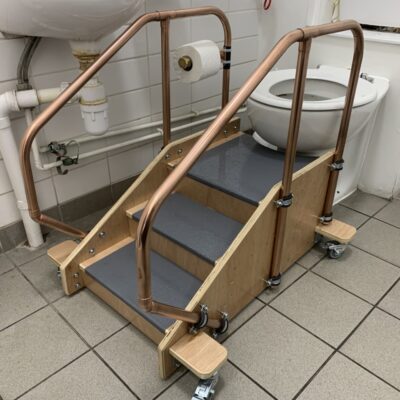
A young adult student of a very small stature (Morquios syndrome) couldn’t reach the toilet bowl to sit on it independently whilst at school (he required lifting to enable him to sit on the toilet, a requirement that nor the school or his carer could accomodate).

The client has severe curvature of the spine and needed lateral support when seated in his Seahorse toiletting chair. A special arm rest was made to replace the exisiting one.

A hand rail to suit a particular transfer method from wheelchair to toilet.

A commercially available padded seat that has been reinforced to cope with a side transfer onto a toilet

Child of 9 with multiple limb amputations requested easer access to toilet when not using prosthetic legs

A simple tube fitted to a urine bottle to empty it into a larger container

A bariatric client with motor neuron disease wishes to self-insert suppositories and enemas while seated over the toilet. A reinforced toilet seat with improved access was provided.

An 81 y-o woman had a Total Hip Replacement (THR). Since she already had home improvements in place (hand rails on stairs and doors, saddle boards removed, radio button alarm, 24/7 carer) she was released from hospital after four days – the only thing she needed and was given was a Rollator (wheeled walking frame, Zimmer frame). She found that the duvet on her bed restricted her movement, and a duvet support was requested for the period of her recovery. A length of 1/8 inch fencing wire was bent to shape and a brass ferrule with two grub screws was made in order to secure the ends of the wire.

Help for children with dwarfism at school and home to reach wash basins, toilets and other places.

A child with significant scoliosis and no head control required a headrest on her shower chair, which could be off-set to the side to support her head.

A school requested Remap to make a folding toilet step for a small pupil but which could also be used by others

A teenage client with Athetoid Cerebral Palsy, has uncontrolled athetoid movements, and needed to have an adapted seat in order to be able to use the toilet whilst away from home for social outings, and whilst away on holiday.

Child receiving end of life care. OT tried a child’s commode chair but the aperture in the middle was too small. Specialist products take several months for delivery. This was too urgent to wait, so the OT asked if the standard product could be adapted.

Client required a support leg for an existing rail beside her toilet. It was not possible to simply replace the rail due to various restraints including a brittle wall, also the leg needed to be freestanding so as to not damage the flooring.

Stable transfer stool enables a girl with the brittle bone disease to use toilet independently.