
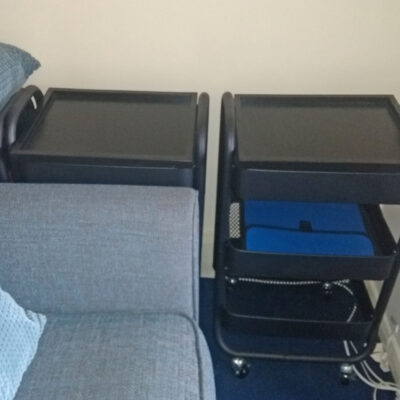
Accessible storage
Accessible storage for unused space adjacent to a fireplace.
Accessible storage for unused space adjacent to a fireplace.
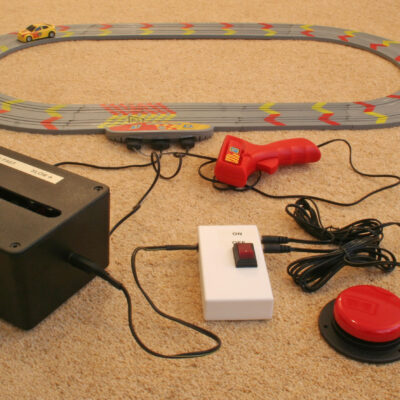
Adapted controls to allow a young boy to control a Scalextric slot car.
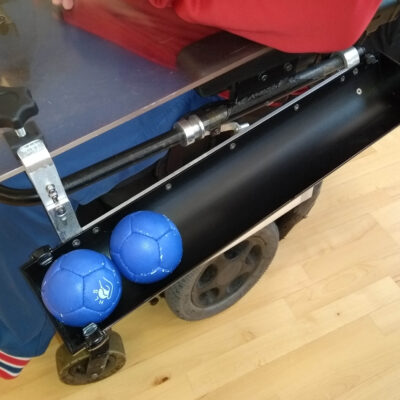
A simple Boccia ball holder to attach to an existing wheelchair table.

A solution to the problem of clients with reduced dexterity and movement needing to urinate at night.

Lizzie has been using painting as a therapy for some time. Her cerebral palsy means that she can’t use her hands to paint and as she is in a wheelchair it makes it difficult for her to paint on a commercially available easel. She needed a head harness to hold the brush and a custom support structure for her work.

Wheelchair carriers for tripod based walking sticks.

A manual pedal go-kart converted to electric operation with a hand throttle, and a radio operated stop switch.

A steel framed bed which was lifted and converted to castors to make it easier for carers to look after the client.

A simple tube fitted to a urine bottle to empty it into a larger container

A 9 year old boy with cerebral palsy uses a recumbent trike to strengthen leg muscles, but he is not strong enough to pedal up hills. The project provides electrical assistance by modifying the trike to add a motor, battery, pedal sensor and control module. This was complicated by the larger wheel required for the motor necessitating relocating the rear brake, fitting a new brake lever with cut out switch and emergency kill switch for the electrics.

For many high-tech assistive communication (AAC) users, it is difficult to see when they are composing a message. We implemented a system that visually indicates when communication software is in use.

Some people with e.g. cerebral palsy are unable to use physical controllers such as buttons and joysticks but are still able to make intentional hand movements. HandShake uses a pair of BBC micro:bits to enable triggers to be sent to switchable communication software to enable speech to be composed. A trigger is sent to the communications device when the participant moves a hand above an adjustable threshold of acceleration.

Rose has cerebral palsy and needs to exercise daily. She has a treadmill available but it is for adults, so the existing hand rails are too high for her since she is only 7 years old. The risk of not being able to hold on to steady herself is too great and there is also a danger of her stepping on the non moving part of the machine in front of her. This make (JLL) is very popular for this purpose since it ca run as slowly as 0.3 km/hr but it is not designed for children. The challenge was to make it safe and suitable for her to use.

Henry has cerebral palsy and needs to exercise as part of his endurance training. He has a JLL treadmill which is popular for this purpose as it can go as slowly as 0.3 Km/Hr which is safe for children like Henry. However, he needs to steady himself and make sure he doesn’t step on the non moving part of the treadmill which could cause him to trip. As he is only 3 the safety rails need to be at the correct height and this is a lot lower than the ones that come with the treadmill.

The client is an 18 year old who has cerebral palsy. He was sharing a room with his brother, sleeping in the bottom bunk with his brother sleeping on the top bunk. The client is now using a profiling bed but with the existing bunk bed still required for his brother the client cannot move around the room in his wheelchair. The request was to modify the existing bunk bed so that the profiling bed could fit under the top bunk.

A child of 4 years with CP and with limited sight required equipment to help with mobility in preparation for school.