
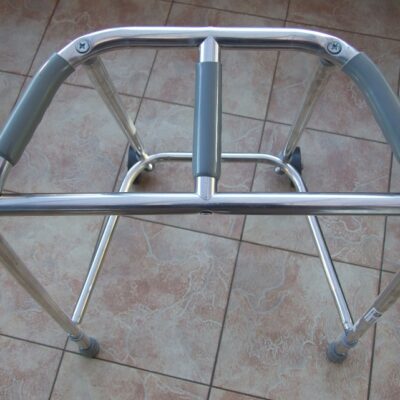
Single handed walking frame
Clients who have had a stroke and only have full use of one arm have difficulty using a walking frame. When picked up by the side handles or by the front crossbar the frame can hit ankles or furniture.
Clients who have had a stroke and only have full use of one arm have difficulty using a walking frame. When picked up by the side handles or by the front crossbar the frame can hit ankles or furniture.

Roy, who had suffered a stroke, was recommended to use an exercise bike to regain use of his legs but had a problem keeping one knee from staying in line with his hip and foot. A rehab physiotherapist recommended Remap to provide a means of doing this, so an extension from the pedal was made to support his leg.
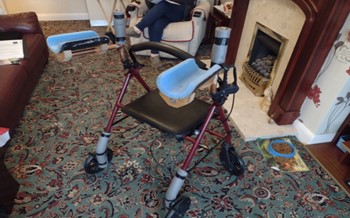
An elderly and frail client needed her 4-wheel walker to be adapted to give her better support to walk within her home. Whilst initially it was thought the support was only needed on one side, it became clear there was a great deal of benefit to adapt both sides and produce a balanced walker with gutter rests.
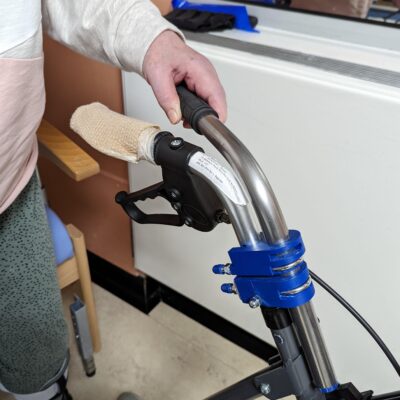
An offset rollator handle
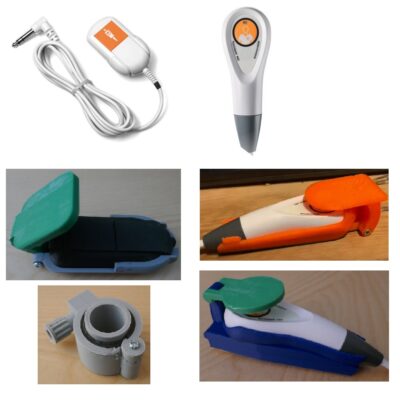
Two further nurse call button cradle designs for Harrogate Hospital wards

After a stroke, the client’s left side weakness means he needs his wheelchair to be adapted to provide additional support to his left arm and something to restrain his left leg to maintain proper posture. A gutter forearm support was added to the armrest and a plywood panel added to restrain the leg.
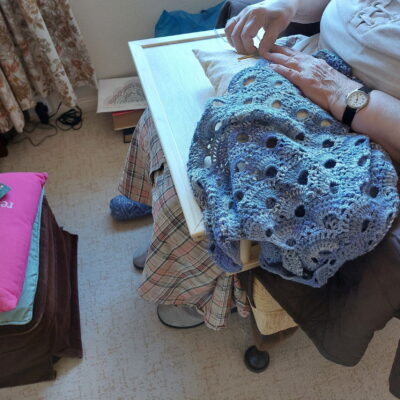
A couple of devices which allow a lady to resume enjoying her hobbies of crochet and knitting despite her suffering tremors and the effects of a stroke.

Adaptation of four-wheel walker for single-handed braking.

Modification of a mini into an assessment car for the East Kent Neuro Rehabilitation Department to be used by their patients for practicing going in and out of a vehicle.
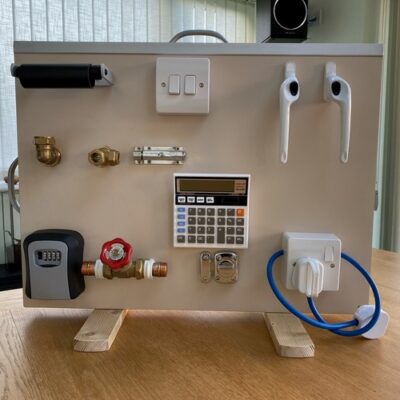
Activity boards for supporting children and adults to improve their fine motor skills.

Remap Essex central were approached by groups caring for people with dementia who wanted a game that could occupy people with dementia whilst also offering a useful way of assessing an individuals health status.

An adaptation to a dinner fork to enable client to eat independently.
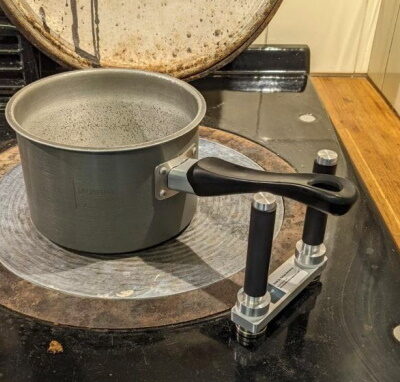
After a stroke, the client was unable to hold pans steady on the stove while cooking. The usual pan holders would not work on his Aga, so a simple bracket held in place by magnets was made.

Raisers for a leather arm chair with low profile timber feet to help a patient after a stroke.

After a stroke, the client struggled to file her fingernails and varnish them. A simple tool was made to allow her to do this one-handed.

The client had suffered a stroke and was unable to use his arm or leg on the left side of his body. His wife was unable to get him into the shower as it was too narrow for a shower chair to be manoeuvred so the client’s Occupational Therapist contacted us to ask for help.